
Hrastovlje: Church, Frescoes and Hotels
Accommodation in Hrastovlje
Hrastovlje is particularly defined by the Church of the Holy Trinity. It is a valuable cultural attraction and is known for its extensive medieval frescoes, including the famous Dance of Death. The church stands in a landscape typical of the Karst, with red soil, stone walls and vineyards.
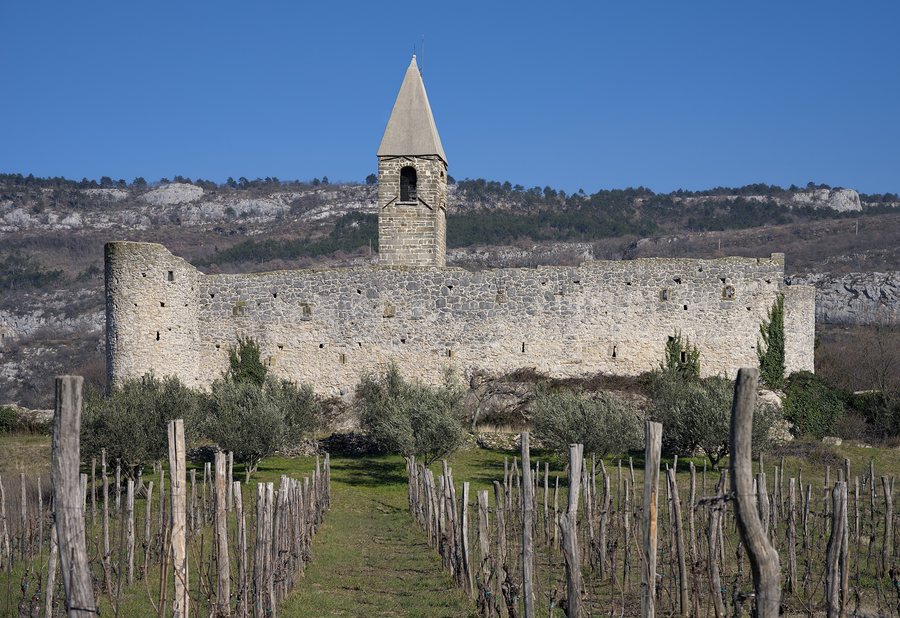 File:Cerkev sv. Trojice - Hrastovlje.jpg
Photo: Photo: This Photo was taken by Miha Peče . Feel free to use my photos, but please mention me as the author. I would much appreciate if you send me an email pc.osx.linux@gmail.com or write on my talk page , for my information. Please do not upload an edite
File:Cerkev sv. Trojice - Hrastovlje.jpg
Photo: Photo: This Photo was taken by Miha Peče . Feel free to use my photos, but please mention me as the author. I would much appreciate if you send me an email pc.osx.linux@gmail.com or write on my talk page , for my information. Please do not upload an edite
Culture
The Church of the Holy Trinity in Hrastovlje is designated as a cultural monument of national importance. Its interior preserves surviving Glagolitic and Latin inscriptions, which are regarded as valuable historical sources. The fresco cycle was painted in 1490 by Janez iz Kastva. The chronology and the different written records are therefore also part of this building. The inscriptions and the fresco cycle are located in the same church interior, combining written tradition with pictorial representation.
A simultaneous limit of no more than 25 visitors applies to church visits. It serves to protect the painted surfaces and maintain a suitable indoor climate. This rule concerns time spent inside the church and is directly related to preserving its sensitive furnishings.
On the hill opposite the Church of the Holy Trinity, beside the road to Dol, stands the Šavrinka statue by academic sculptor Jože Pohlen. Pohlen gave the statue to Hrastovlje in 1990 as a symbol of Slovenian Istria. Its location opposite the church and its dedication to Hrastovlje connect the artwork with the village and its regional character.
History
Hrastovlje is one of the Istrian villages associated with the Šavrinka traders. These women transported goods between central Istria and the coastal towns. Šavrinke were young women and girls from Slovenian Istria; in the coastal towns, they worked as domestic helpers or sold various agricultural products. The term thus refers both to their origin and to their various activities in the coastal towns.
Landscape
Hrastovlje is characterised by stone houses, densely built-up lanes and portals made of white Karst stone. In the village, houses, lanes and portals define the townscape; the Church of the Holy Trinity stands in a landscape typical of the Karst, with red soil, stone walls and vineyards. This makes both the village's architectural character and the landscape with its distinctive elements visible.
Hiking
The P2 trail leads to a viewpoint overlooking Koper, Trieste and large parts of Istria. The Galerija Pohlen is also located at a fork in this trail. Thus, the trail route, viewpoint and gallery are connected along the same named route, without any further information about length, duration or difficulty being implied.
The P4 trail offers views from the long Kuk-Lačna ridge over the Karst rim, the interior of Istria and the Bay of Koper. In the views mentioned, it therefore differs from the P2 trail: Koper, Trieste and large parts of Istria are explicitly named there, while the P4 trail places the Karst rim, the interior of Istria and the Bay of Koper in the foreground.
You can find more pages about local places here: Zgornje Škofije, Ankaran, Pobegi, Tinjan, Dekani, Osp, Črni Kal, Krkavče.
For the overarching travel overview: Koper.
