
Pryvoz Market in Odesa: atmosphere, goods, and visiting respectfully
Pryvoz Market is one of Odesa’s best-known historic trading places. Its history began in 1827 as part of the Old Market, where traders sold goods brought into the city by cart. The surviving market buildings were constructed later. Its architectural history spans several eras.
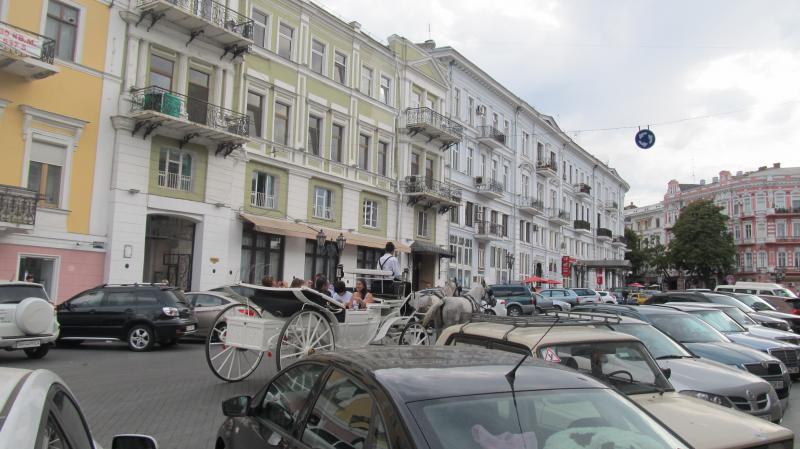 Historische Häuserzeile in Odessa mit Pferdekutschen und Stadtverkehr als Bild für das urbane Umfeld des Marktes.
Photo: daddy
Pryvoz Market at a glance
- The market dates to 1827 and began as part of the Old Market.
- The name “Pryvoz” refers to goods brought in.
- In the 19th century, much of the trading on the market square took place directly from carts and wagons.
- The Fruit Arcade complex was built in 1913, comprising four two-storey buildings with arched gateways.
- A new meat hall was added in 1958.
- Ukraine’s airspace is closed.
From the Old Market to a trading hub
Odesa’s city tourism office dates Pryvoz to 1827. At the time, the site was part of the Old Market and served traders bringing goods into the city. The name derives from this role. A local historical essay describes the early market area as largely open, with few substantial permanent buildings; goods were sold directly from carts and wagons, among other ways.
The stone halls were built long after the market was established in 1827. Simple wooden shops and makeshift stalls appeared over the course of the 19th century. The open area remained important because carts brought in goods and needed room to maneuver. Pryvoz’s history shows how a practical supply point grew into a defining part of everyday local life.
The city of Odesa and its trading history provide the geographic context. Combine your interest in markets and cafés with regional cuisine. The market’s history brings together the city’s past and the architecture of the old town.
The Fruit Arcade complex and later buildings
One of the most distinctive historic building groups is the Fruit Arcade. Built in 1913, it comprises four two-storey buildings linked by arches and gateways. Each section had ten trading rooms on the ground floor, with deep cellars below. The complex shows how permanent market architecture gradually grew up around what had previously been an open trading area.
Another important chapter began in 1958 with the construction of the meat hall. It provided a larger covered trading area for a specific category of goods. Pryvoz’s architectural history is therefore made up of several layers: the tradition of an open square, the 1913 Fruit Arcade complex, and later specialized halls. This development is distinct from the founding of the market itself.
Those interested in urban history can compare the market’s architectural development with Odesa’s other commercial and street spaces. A market is both an economic hub and a public urban space, so the history of its buildings can be linked to urban development, food supply, and architecture. Restaurants in Gomel are an example of culinary urban spaces beyond Odesa.
Ukraine’s airspace is closed; entry and exit are possible only by land.
When planning your trip, consider the checklist for planning your time, maps saved for offline use, and advice on cash and payments. Choose your accommodation for longer holiday stays based on how easy it is to get to your daily destinations.
Factor transfers and local transport into your daily routes. A peaceful stay in natural surroundings is a different kind of trip from a historic market walk.
Frequently asked questions about Pryvoz Market
Why is the market called Pryvoz?
The name refers to goods brought in. The market began as part of the Old Market, where traders sold their products directly from wagons.
When was the Fruit Arcade built?
The complex was built in 1913. It consists of four two-storey buildings connected by arches and gateways.
Who designed the Fruit Arcade?
The local historical essay credits the design to Odesa architect F. P. Nesturkh.
When was the meat hall added?
The historical overview dates construction of the meat hall to 1958.
