
Klaipėda Sea Museum: Aquarium and Curonian Spit
The Lithuanian Sea Museum is located in Nerija Fortress on the Curonian Spit, opposite Klaipėda. Its aquarium and maritime exhibitions connect the landscape of the Curonian Lagoon with the history of seafaring and the port.
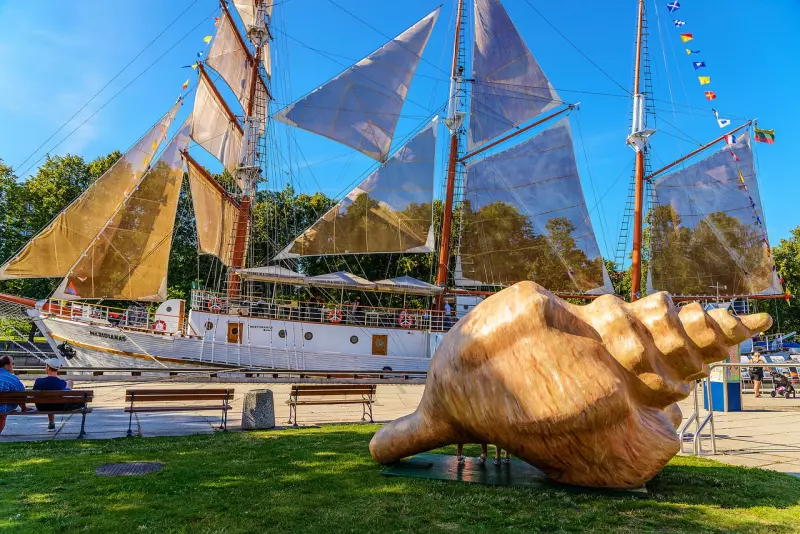 Segelschiff am Ufer von Klaipėda neben einer großen Muschelskulptur.
Photo: leonid927 auf Pixabay
Key facts about Klaipėda Sea Museum
- The museum is located in Nerija Fortress on the Curonian Spit.
- The fortress was built between 1865 and 1871 to protect the entrance to the port.
- The museum has used the fortress since 1979.
- The aquarium features freshwater, the Baltic Sea, the North Sea, and tropical seas.
- The casemates, corridors, and caponiers house maritime history exhibitions.
- Two ferry terminals connect Klaipėda and Smiltynė; their vehicle rules differ.
Nerija Fortress at the entrance to the port
Construction of Nerija Fortress began in 1865 and continued in stages until 1871. Together with the Wald Fortress built on the mainland, it was intended to secure access to the port of Klaipėda. The hexagonal rampart is surrounded by a defensive ditch; inside are a central redoubt, casemates, and former powder magazines.
During the occupation of the city in the First World War, the fortress served as a refuge for residents for a few days. In the Second World War, German troops blew up the central redoubt. The Sea Museum has used the site since 1979: the redoubt houses part of the aquarium, while the casemates and caponiers display maritime history.
Aquarium and maritime history
The tour leads from Lithuanian streams and lakes through the Baltic and North Seas to tropical waters. The tanks illustrate four ecosystems and feature fish and invertebrates from different seas. An acrylic tunnel offers views of sturgeons, while other tanks showcase the diversity of freshwater and marine life.
The maritime exhibitions are housed in former defensive spaces. The casemates, corridors, and caponiers explore the development of the Lithuanian fleet, shipwrecks, sailing in Klaipėda, and the history of navigation. Historic anchors and the fortress layout link the history of technology with the former harbor fort.
The museum is located in Smiltynė on the Curonian Spit. The complex also includes areas devoted to marine mammals and birds, traditional fishing homesteads, and historic ships. The dolphinarium and marine animal rehabilitation center are also part of the institution, with their own programs and operating areas.
Ferry to Smiltynė
The crossing from Klaipėda to Smiltynė goes across the Curonian Lagoon. The old ferry carries pedestrians, bicycles, and pets, but not motor vehicles. The new vehicle terminal serves cars and buses as well as pedestrians and cyclists. Choose the terminal according to your mode of transport.
The old ferry departs from the city center, near where the Danė flows into the lagoon; the vehicle terminal is farther south. Special ferries also run directly to the Sea Museum and dolphinarium. Seasonal departure intervals vary, and current timetables depend on the travel date. From May 25 to November 30, 2026, construction work means access to the Old Ferry will be via Memelio miestas; the landing remains at its usual location. Plan the onward journey on Smiltynė and the return crossing as part of the same day as your museum visit.
Klaipėda and the Curonian Spit
The museum is in Lithuania, on the country’s western edge. The passenger ferry connects Klaipėda with Smiltynė; on the spit are Neringa, Nida, and Juodkrantė. Palanga adds another stop to the coastal route north of Klaipėda. The Curonian Spit is a UNESCO World Heritage cultural landscape, with distinct stretches between its settlements.
A cross-border trip through the Baltic States can combine Lithuania’s coast with Estonia and Tallinn. Inland in Lithuania, Vilnius and Kaunas offer an urban counterpoint to the spit and the Baltic Sea. The Baltic States lend themselves to multi-country routes, while a shorter trip in Lithuania leaves more time for the west coast.
Where you stay affects the day’s itinerary: from Klaipėda, the first leg is to the ferry terminal, while accommodation in Neringa is already on the spit. Palanga is another coastal base; the distance to the ferry affects both departure and return travel. When choosing accommodation, consider its location together with your planned day’s route. Those adding nature destinations will find that coastal paths and dunes offer a different focus from the cities. On a longer round trip, Vilnius and Kaunas are inland and require separate travel legs. A route through the Baltic States combines these city stops with the coast and neighboring countries. Vilnius is Lithuania’s capital, while Kaunas, the country’s second-largest city, offers another urban focus.
Getting there and visiting
According to the museum, the Sea Museum is 1.6 kilometers from the passenger ferry landing in Smiltynė. You can walk or cycle there, or take the paid mini-trains, which run according to the ferry timetable. Cars travel to Smiltynė via the New Ferry Terminal; the passenger ferry at the Old Terminal does not carry motor vehicles. Choose your terminal and onward route according to your mode of transport.
The aquarium and museum exhibitions have seasonal opening days and admission prices. A visit to the dolphinarium requires a separate ticket for the particular show; show times and prices also vary by season. Build the ferry crossing, a buffer for arrival, and your booked show time into the day’s itinerary. The museum ticket office accepts cash and bank cards; the vending machines by the dolphinarium accept bank cards. For trip planning, include the ferry crossing, seasonal opening hours, and return journey in the same schedule. Getting there and transportationshould be planned around the ferry terminal you choose. For money and payments, note that the vending machines by the dolphinarium accept card payments only; for language and communication, visitors can have important information and ticket details ready before their visit.
The Lithuanian Sea Museum website publishes seasonal opening hours and admission prices for the aquarium, exhibitions, and dolphinarium.
Frequently asked questions about Klaipėda Sea Museum
Where is the Sea Museum located?
It is in Nerija Fortress on the Curonian Spit, opposite Klaipėda.
What can you see in the aquarium?
The tanks take you from freshwater through the Baltic and North Seas to tropical seas; an acrylic tunnel features sturgeons.
How large is the biggest aquarium tank?
The largest tank holds 50 tonnes of water. A distinctive feature is a dome-shaped recess where visitors can observe fish up close.
Which ferry carries cars?
The new vehicle terminal carries motor vehicles and buses. The old ferry in the city center takes pedestrians, bicycles, and pets, but not cars.
